Trending


Kidnapping in Nigeria is no longer just a crime affecting individual families. It has grown into an economy that is helping to sustain some of the country’s most dangerous armed groups.
A new report by SBM Intelligence reveals just how much money is changing hands.
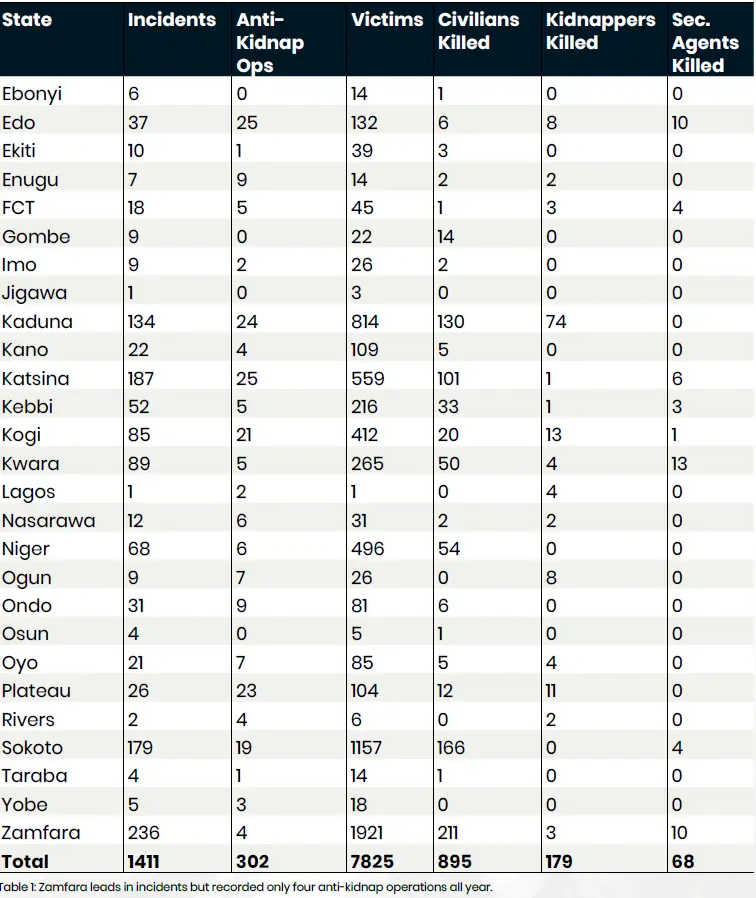
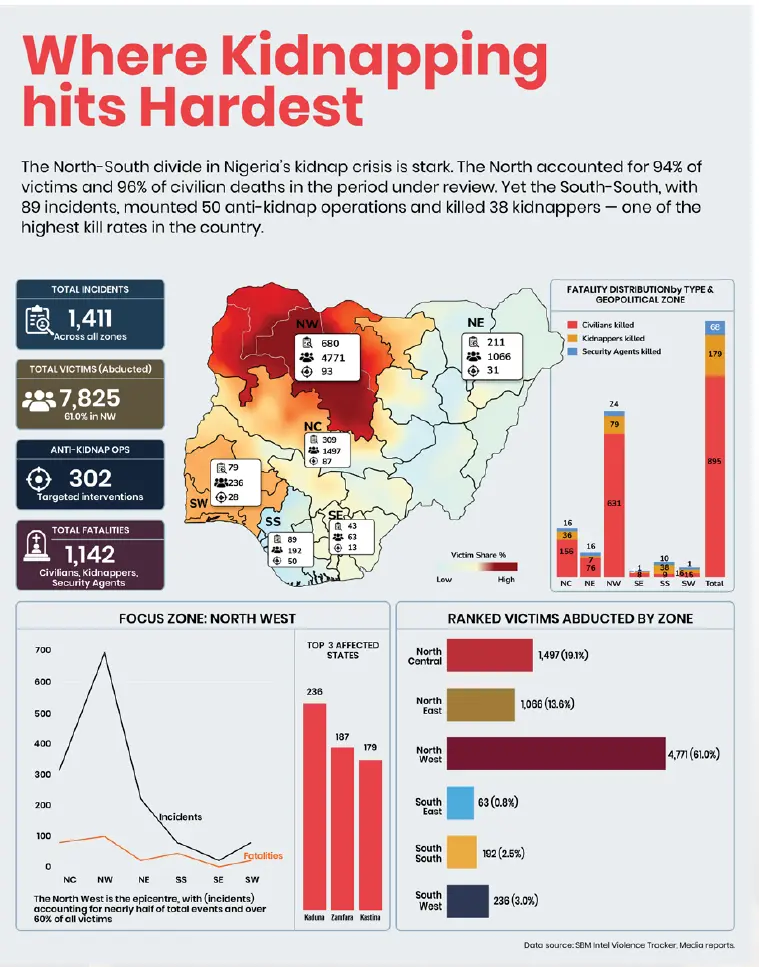
Between July 2025 and June 2026, at least 7,825 people were abducted in 1,411 kidnapping incidents across Nigeria. At least 1,142 people were killed during the period.
Read More : Africa’s Energy Shock Tests Economic Reforms
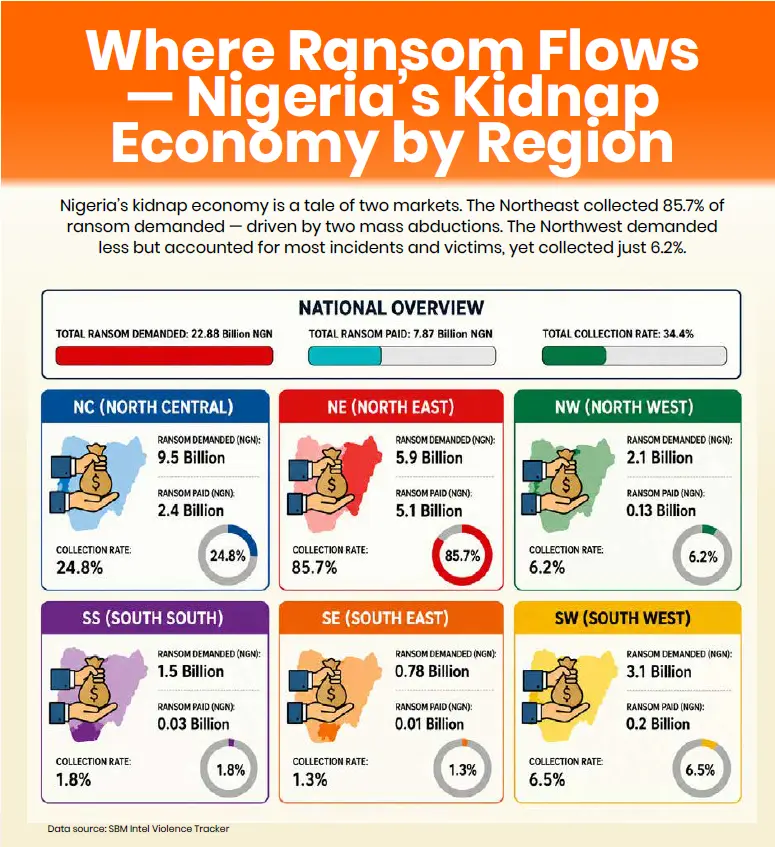
But behind these troubling figures is an even more worrying development: one faction of Boko Haram collected 90% of all recorded ransom payments in Nigeria during the year.
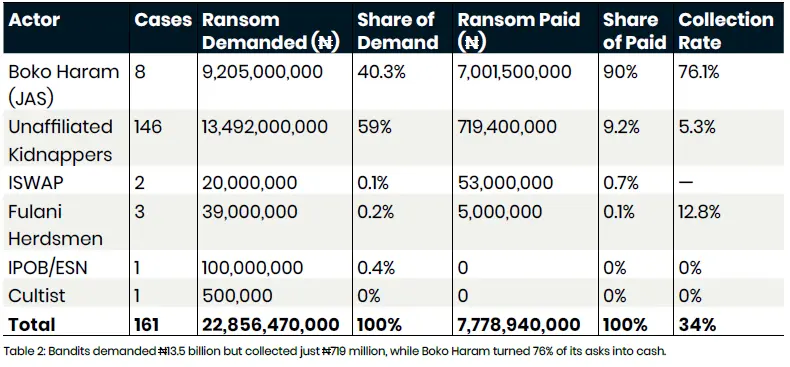
The report, The Capture of Nigeria’s Kidnap Economy, found that kidnappers demanded about ₦22.86 billion in ransom and received roughly ₦7.78 billion.
That means families and communities paid more than a third of the total amount demanded.
And unlike previous years, where ransom demands were often made by numerous criminal groups, much of the money this time went to one terrorist faction.
One terrorist group took most of the money
The numbers tell a striking story.
The JAS faction of Boko Haram demanded about ₦9.2 billion from eight incidents and collected approximately ₦7 billion — a collection rate of 76.1%.
By comparison, kidnappers and bandit groups demanded about ₦13.5 billion across 146 incidents, but received only ₦719.4 million.
In simple terms, the criminal groups made more demands, but the terrorist faction was far more successful at getting families to pay.
Two major incidents explain much of the difference.
In April 2026, 416 people were abducted from Ngoshe in Gwoza, Borno State, with the kidnappers demanding ₦5 billion. The full amount was reportedly paid.
Months earlier, 315 pupils and staff were abducted from St Mary’s School in Papiri, Niger State, with multiple intelligence sources putting the ransom at ₦2 billion.
Together, the two incidents generated ₦7 billion, almost the entire ransom amount collected by the Boko Haram faction during the period.
The significance goes beyond the money.
For the first time since SBM began tracking the kidnap economy, the largest ransom demanded and the largest ransom paid were exactly the same — ₦5 billion.
That suggests that some armed groups now have enough power and leverage to demand huge sums and actually get them.
Mass kidnappings are becoming the norm
Nigeria is also seeing a shift in the way kidnappers operate.
Of the 1,411 kidnapping incidents recorded by SBM Intelligence, 396 involved five or more victims.
Those incidents represented just 28.1% of all cases but accounted for 6,222 victims — nearly 80% of everyone abducted.
That means most victims were not taken one or two at a time. They were swept up in large-scale attacks on communities, schools, churches and roads.
The Northwest was particularly badly affected, accounting for 267 of the 396 mass-abduction incidents.
Zamfara recorded 92 mass abductions involving 1,722 victims, while Sokoto recorded 76 incidents involving 974 victims.
The return of school kidnappings is especially worrying.
The Papiri school attack and the abduction of schoolgirls in Maga, Kebbi, show that schools remain attractive targets for armed groups.
And when children are abducted, the damage does not end when the victims are released. Parents become afraid to send their children to school, schools may close, businesses suffer and families can be forced to leave their communities.
Farmers can also abandon their land because they fear being kidnapped while working, creating another threat to food production.
Northern Nigeria carries the heaviest burden
The figures show a huge divide between northern and southern Nigeria.
Of the 7,825 people abducted during the reporting period, 7,334 were taken in the North. That represents 93.7% of all victims.
The Northwest recorded the highest number of incidents, with Zamfara topping the list.
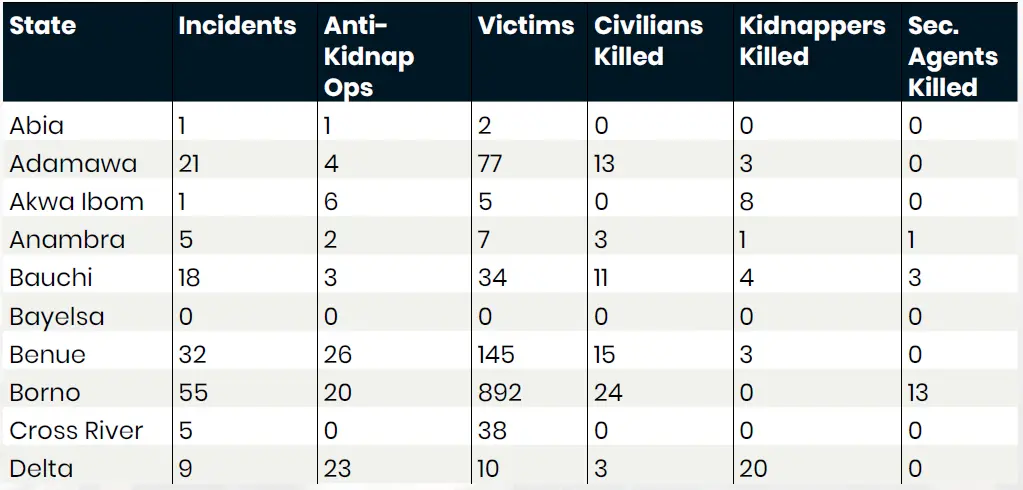
Zamfara recorded 236 kidnapping incidents and 1,921 victims, while Sokoto recorded 179 incidents involving 1,157 victims. Kaduna followed with 134 incidents and 814 victims.
The report links the severity of the crisis in the North partly to geography.
Large rural areas, forests and limited security coverage give armed groups space to operate and hold victims.
In some areas, victims are reportedly forced to work in farms and artisanal mining operations controlled by armed groups. This means kidnapping can generate not only ransom but also labour.
Ransom does not always save victims
Perhaps the most painful finding is that paying ransom is not a guarantee that a hostage will come home alive.
SBM identified at least six cases in which victims were killed after ransom was paid.
In one case in Kwara, five of eight worshippers abducted from an ECWA church were killed despite a reported community payment of ₦20 million.
Other victims, including a pastor, a monarch, a businessman and a teacher, also died after their families reportedly paid ransom.
Even people who step forward to deliver ransom are increasingly being targeted.
The report identified at least six cases where ransom-bearers were themselves abducted. Among them was a Chief Imam in Sokoto who went to deliver ransom for relatives.
And as families struggle financially, kidnappers are adapting.
In at least 14 incidents, they demanded items instead of, or alongside, cash. These included motorcycles, rice, food, fuel, smartphones, recharge cards and other everyday goods.
The security response is uneven
Nigeria recorded 302 anti-kidnap operations during the period, but the distribution of those operations raises questions.
Zamfara, despite recording the country’s highest number of kidnapping incidents and victims, recorded only four anti-kidnap operations throughout the year.
Benue, by comparison, recorded 26 operations against 32 kidnapping incidents. Katsina, Edo and Kaduna also recorded relatively high levels of security activity.
This does not necessarily mean that security agencies are doing nothing in Zamfara. Instead, it may point to how difficult it has become to contain armed groups operating across large and difficult terrain.
The situation in Gombe also deserves attention. The state recorded a sharp increase in kidnapping and deaths but had no recorded anti-kidnap operation during the period covered by the report.
The cost goes far beyond ransom
The billions paid to kidnappers are only part of the damage.
Every ransom payment represents money that families could otherwise have used for school fees, healthcare, business, farming or investment.
Businesses also face higher security costs, while persistent insecurity can discourage investors.
Agriculture is particularly vulnerable. When farmers stop going to their farms because of kidnapping, production falls. When schools close, children lose valuable learning time. When communities are displaced, local businesses and livelihoods disappear.
The danger becomes even greater when ransom money ends up financing terrorist organisations.
SBM Intelligence warns that the ₦7 billion collected by the Boko Haram faction represents more than a criminal transaction. It can provide resources for weapons, fighters and operations, potentially helping to sustain the same violence that creates more kidnappings.
What can be done?
There is no single solution to Nigeria’s kidnapping crisis. But the data points to several areas where government can act.
1. Follow the money
Security agencies and financial intelligence authorities need to become better at tracking ransom payments and identifying the people who facilitate the movement of the money.
If terrorist groups are increasingly relying on ransom as a source of funding, cutting off that financial pipeline should be treated as part of counterterrorism.
2. Improve intelligence and rapid response
The government needs better intelligence gathering, surveillance and rapid-response capacity in kidnapping hotspots.
Security agencies should focus not only on responding after an abduction but also on identifying routes, camps and networks used by kidnappers before attacks happen.
3. Protect schools and vulnerable communities
Schools in high-risk areas need stronger security arrangements, early-warning systems and reliable emergency response mechanisms.
Communities should also have ways to quickly report suspicious movements and threats without putting residents at further risk.
4. Support local security structures
Community-based security groups can provide valuable information because they understand the terrain and know the communities.
However, they must operate within a coordinated system involving the police, military and other security agencies, with proper oversight and accountability.
5. Protect farmers and rural livelihoods
Security cannot be separated from the economy.
Farmers need to be able to reach their farms safely, while rural roads, markets and settlements require better protection.
Keeping communities economically active can also reduce the desperation and unemployment that armed groups exploit for recruitment.
6. Develop a coordinated approach to ransom
Families facing the abduction of a loved one are placed in an impossible position: refusing to pay can put a hostage at risk, while paying can strengthen the criminals holding them.
Government needs a professional hostage-response framework that supports families, improves negotiations and prioritises safe rescue operations.
Where feasible, Nigeria should also work towards a credible no-ransom policy, particularly in cases involving terrorist organisations, while recognising that hostage situations require careful case-by-case management.
7. Tackle the roots of insecurity
Security operations alone will not solve the problem.
Nigeria must also address the conditions that allow armed groups to recruit, operate and control territory. Better access to education, jobs, dispute resolution, basic services and effective local governance can help close some of the gaps that armed groups exploit.
A crisis that demands more than arrests
The latest figures paint a worrying picture of Nigeria’s kidnapping crisis.
Thousands of people have been abducted, hundreds killed and billions of naira paid in ransom. More importantly, the money is increasingly finding its way to highly organised groups capable of using mass abductions to generate huge revenues.
The fact that one Boko Haram faction collected 90% of recorded ransom payments from just eight incidents should be a wake-up call for policymakers.
Nigeria cannot treat each kidnapping as an isolated criminal incident.
The country needs to attack the problem from both ends: make kidnapping less profitable while making communities less vulnerable to recruitment, violence and displacement.
That means following the money, strengthening intelligence, protecting schools and rural communities, supporting farmers and livelihoods, and building a more coordinated hostage-response system.
Until those pieces come together, Nigeria risks allowing kidnapping to evolve from a criminal enterprise into a reliable funding stream for the very armed groups threatening the country’s security and stability.