Trending
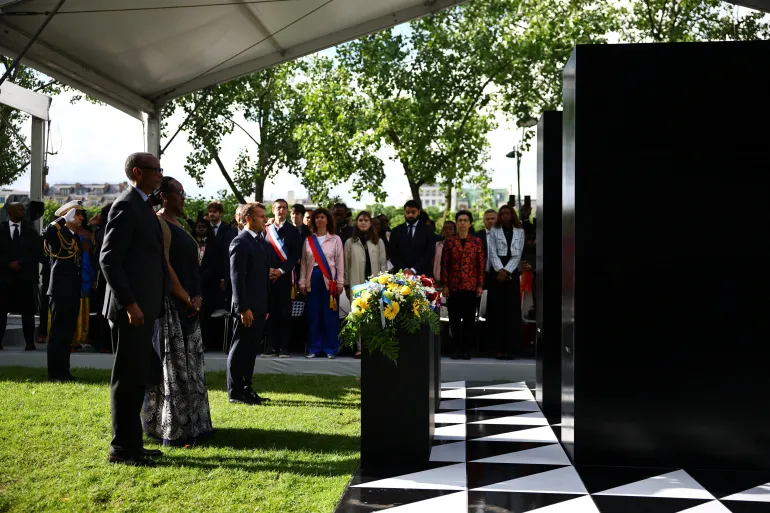
French President Emmanuel Macron and Rwandan President Paul Kagame have inaugurated a monument in the French capital, Paris, in memory of victims of the Rwandan genocide.
Speaking at the event on Tuesday, Macron described the memorial as “the culmination of a long and patient quest for truth.”
“In a world where empires sometimes have the temptation to falsify history, in this moment also where the past is a battlefield, telling the truth is more necessary than ever. This is the condition for peace,” he said.
Read More : Rwandan Filmmaker Opens Doors Behind Camera
Rwandan government officials have, over time, blamed the international community for ignoring warnings about the killings, while some Western leaders have expressed regret.
In a historic speech in Kigali in 2021, Macron acknowledged France’s failure to heed warnings of the impending massacres in Rwanda.
Kagame told those gathered at the event that France is in a unique position to observe and to act.
“It took too long for France to come to terms with its role in causing additional pain, and on some points we still have not reached consensus,” Kagame said.
The Rwandan president added that no country “has gone as far as France in setting the record straight and accepting its part in the tragedy.”
The monument, titled The Archive, consists of two black brass steles created by Berlin-based Portuguese artist Grada Kilomba, and serves as a memorial to the victims.
According to AFP, it bears an engraved tribute to the estimated 800,000 men, women, and children—mostly ethnic Tutsis—who were massacred between April and July 1994.
Read More : Rwanda Rebukes Muhoozi Over Ethnic Remarks
“Here, like an archive, rest the voices and words, the memories and experiences, the feelings and hopes of the victims and the survivors,” the inscription reads.
The genocide was triggered after President Juvénal Habyarimana’s plane was shot down on April 6, 1994, killing the leader, who was an ethnic Hutu.
The Tutsi minority was blamed for the attack. In the aftermath, Hutu extremists launched mass killings of Tutsis and moderate Hutus, with support from the army, police, and militias.