Trending
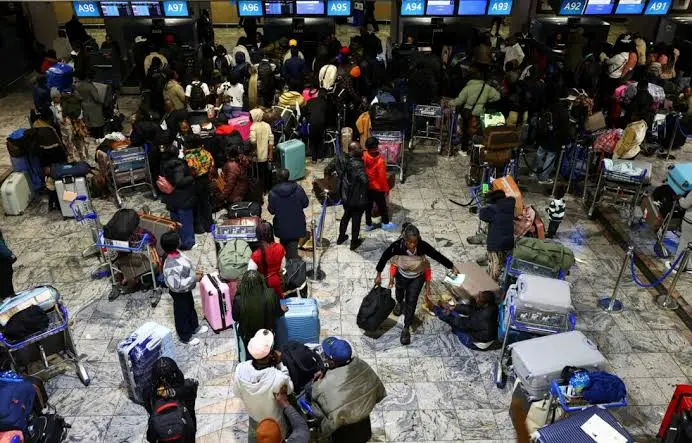
Nigeria has evacuated 1,695 citizens from South Africa this year following renewed threats against foreigners, an envoy has said.
Acting High Commissioner to South Africa, Ambassador Ajayi Alexander, disclosed the figure on Friday during a visit by MTN Media Innovation Programme fellows in Pretoria. He said 1,490 Nigerians returned through government-funded arrangements, while 205 were repatriated with support from private individuals.
The Nigerian Government funded five repatriation flights, each carrying at least 200 Nigerians, while the mission provided additional one-way tickets for others seeking to return.
Read More : Mob Beats Foreigner to Death in Durban
Alexander said the evacuations were voluntary, noting that some Nigerians who registered for the flights did not eventually travel.
Some of those repatriated owned property in South Africa, while others were legal residents affected by delays in renewing their residence permits.
The mission is preparing for another evacuation after the Redeemed Christian Church of God offered to sponsor the return of 500 Nigerians. Alexander appealed to other religious organisations and private individuals to support further evacuations.
The move follows new threats from anti-immigrant groups in South Africa, who have reportedly ordered foreigners to leave by the end of September.
“We are not taking that threat lightly,” Alexander said, adding that protecting Nigerians from violence remained the mission’s priority.

Despite the threats, he said relations between Nigeria and South Africa remained strong at the highest level of government.
“There is a good relationship between the governments at the highest level,” he said.
In July, South Africa’s Minister of International Relations and Cooperation, Ronald Lamola, led a delegation to Abuja following President Bola Tinubu’s directive for talks over attacks on Nigerians. Nigeria has described attacks on its citizens in South Africa as a recurring problem.
Minister of State for Foreign Affairs, Ambassador Sola Enikanolaiye, previously said 98 Nigerians had died in mob and hate-related incidents since 2022.
Alexander said Nigeria and South Africa had agreed on five areas of cooperation, including prevention, prosecution of offenders, restraint by public officials, respect for the rule of law and possible compensation for Nigerians whose property was damaged or abandoned.
However, a proposed early-warning mechanism remains unresolved.
Read More : Bomb Threat Grounds South Africa Flight
The mechanism would allow both countries to share information and respond to potential threats before they escalate. Alexander said negotiations had continued for six to seven years.
Nigeria has signed its side of the agreement, while South Africa has completed its part, but the mechanism is yet to become operational.
The latest threats have revived memories of the 2019 xenophobic attacks, which led Nigeria to organise voluntary repatriation flights for citizens who wanted to return home.