Trending

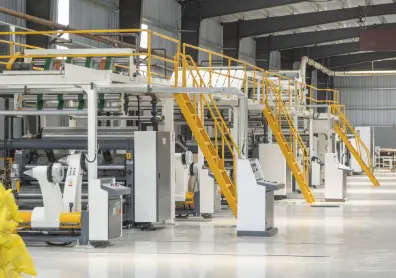
Shared power, water and wastewater treatment services have helped reduce the upfront costs of setting up textile factories in African industrial parks, creating new opportunities for local cotton processing.
Instead of financing all the infrastructure themselves, manufacturers can pay to use services provided by industrial park developers. This reduces the initial investment needed to start spinning, dyeing and finishing operations.
Wastewater treatment plants are already operating in industrial zones in Ethiopia, Benin and Togo. These parks also offer factory sites, electricity connections and logistics services.
Read More : Brazil Votes in Knife-Edge Runoff
The approach could help African countries turn more of their locally grown cotton into yarn, fabric and clothing. However, textile production requires reliable energy and water supplies, especially for processes such as bleaching, dyeing and finishing.
Rajeev Arora, a Kenya-based cotton, textile and apparel specialist, said shared infrastructure could help connect different stages of textile production and support cleaner manufacturing.
“Plug-and-play green parks can bring spinning and garment production together with centralised water treatment, maximising efficiency through shared infrastructure,” he said during an online discussion hosted by the Africa Cotton, Textile and Apparel Centre in October.
Research by the Nigerian Economic Summit Group has also found that shared infrastructure can lower industrial investment costs and help businesses benefit from economies of scale.
Common facilities such as wastewater treatment plants, testing laboratories, logistics hubs and transport links allow companies to access services they might struggle to finance independently.
Ethiopia’s Hawassa Industrial Park exemplifies this model. According to the country’s Industrial Parks Development Corporation, its wastewater treatment plant can process 11 million litres of wastewater daily. The city administration has reported a 90 per cent water recovery rate.
The plant uses a system known as zero liquid discharge. It treats industrial wastewater so the water can be reused within the park. Factories receive access to the service through their location in the industrial zone. However, the public institution managing the park also carries part of the operating costs.
A World Bank study found that operating Hawassa’s treatment plant cost $3.40 per cubic metre of wastewater. Factories paid $0.80 per cubic metre treated during the study period.
The difference highlights a key challenge. Although shared services reduce the costs manufacturers face when establishing factories, developers may have to cover part of the expense of keeping those services running.
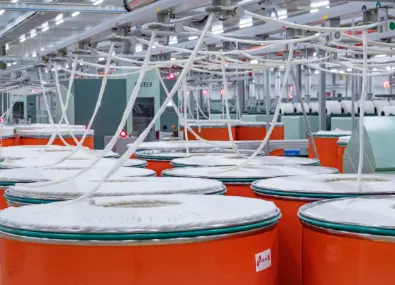
The World Bank also identified high electricity consumption, staff training and service contract arrangements as important issues for the plant’s long-term operation. It questioned whether the fees collected from tenants were enough to make the facility financially sustainable.
A separate study cited by the bank proposed a treatment charge of $1.50 per cubic metre and selling recovered water for $0.37 per cubic metre.
The need for such facilities grows as more textile production takes place locally. Cutting and sewing imported fabric require less water and waste treatment services than processing raw materials through bleaching, dyeing and finishing.
Oluwambe Akinmoye, a Nigerian industrial designer and textile specialist, said manufacturers should invest in systems that reduce resource use and waste.
“New industries should recover and reuse materials and water wherever possible,” he said.
He identified low-energy machinery, water-saving processes and wastewater treatment before disposal as important investments for the sector.
The United Nations Environment Programme identifies wet processing, including bleaching, dyeing and finishing, as a major source of climate impact across the textile value chain. The International Labour Organisation has also described these processes as energy-intensive because they often rely on coal or natural gas to produce steam.
Meanwhile, shared infrastructure is becoming part of efforts to attract textile investment in West Africa. An International Finance Corporation (IFC) review updated in March 2026 recorded operational common effluent treatment plants at the Glo-Djigbé Industrial Zone in Benin and the Adétikopé Industrial Platform in Togo.
At Glo-Djigbé, textile operations achieve an internal water reuse rate of 85 to 90 per cent, according to the review. However, factories producing heavily polluted wastewater must treat it before discharging it into the common system. This places responsibility on individual manufacturers and the park operator.
The International Trade and Research Centre has proposed expanding the model through industrial parks offering shared wastewater treatment, renewable energy, laboratories and waste recovery services.
In an October analysis, the centre argued that sharing these facilities could spread investment costs across manufacturers and give smaller businesses access to environmental services.
It also linked the approach to the competitiveness of African textile suppliers, particularly in areas such as energy reliability, resource costs and environmental information required by international buyers. However, access to greener technology does not always guarantee higher profits.
Dr Debanjan Das, an associate professor in the Department of Fashion, Design and Merchandising at West Virginia University, said commercial returns varied across the six countries he examined.
He noted that factories in Ethiopia faced infrastructure, technology and workforce challenges. Meanwhile, manufacturers in Portugal had encountered buyers unwilling to pay higher prices for environmentally friendly products.
“Green practices can improve environmental performance and competitiveness, but the financial returns have not necessarily followed,” Das said during a webinar on October 22.
He urged manufacturers to begin with energy, water and waste projects that could deliver financial returns. He also encouraged factories to improve transparency through production records and real-time reporting for buyers.
Financing remains another challenge for African textile manufacturers. Arora proposed combining development finance, commercial loans and equipment leasing to support new investments.
Manufacturers could lease low-water dyeing equipment and automated looms through machinery suppliers and leasing companies. This would reduce the upfront capital required to establish a mill.
“Concessional grants can support feasibility studies, technical assistance and vocational workforce training,” Arora said.
He also called for stronger links between vocational institutions and manufacturers. Machinery suppliers, he said, could help training centres obtain modern equipment and prepare local workers to operate and maintain factory systems.
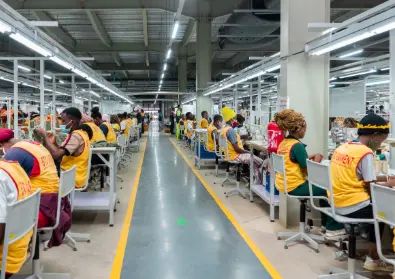
Garment workers mark and prepare fabric for clothing production at a factory in the Glo-Djigbé Industrial Zone (GDIZ) in Benin. Credit: Bird Story Agency.
Renewable energy could also support the expansion of textile parks, although projects remain at different stages of development. The IFC review said the ARISE industrial zones it assessed relied on national electricity grids, with generators available for emergencies. The company was considering renewable energy sources, including rooftop solar.
In Togo, Adétikopé’s developer has also published plans for a solar plant to supply the industrial platform. One proposed financing model involves an independent power producer supplying electricity under a 20-year power purchase agreement.
However, the project description lists feasibility work and environmental assessment among its development stages. It does not confirm that the proposed solar plant is operational.
Energy efficiency is particularly important for textile production because factories need electricity to run machinery and heat water, and drying processes also consume significant energy.
Akinmoye said solar and wind power could support some factory operations, although they might not meet the needs of every energy-intensive machine. He urged manufacturers to combine renewable energy with lower-power technologies.
Environmental monitoring is also essential. The IFC review calls for checks on possible effects on community groundwater supplies around the Benin and Togo industrial zones, where factories draw water from deep aquifers.
Read More : ANC Faces Voter Backlash Over Municipal Failures
As African countries seek to increase local cotton processing, shared utilities could help manufacturers reduce initial costs and access services that individual factories might struggle to provide.
However, the model’s long-term success will depend on reliable services, sustainable financing, efficient technology, and a skilled workforce. These factors will help determine whether industrial parks can support competitive textile production while managing its environmental impact.
Credit: Seth Onyango by Bird Story Agency.