Trending
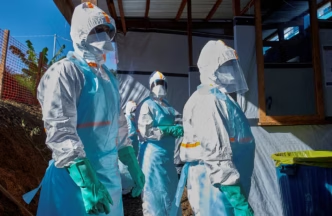
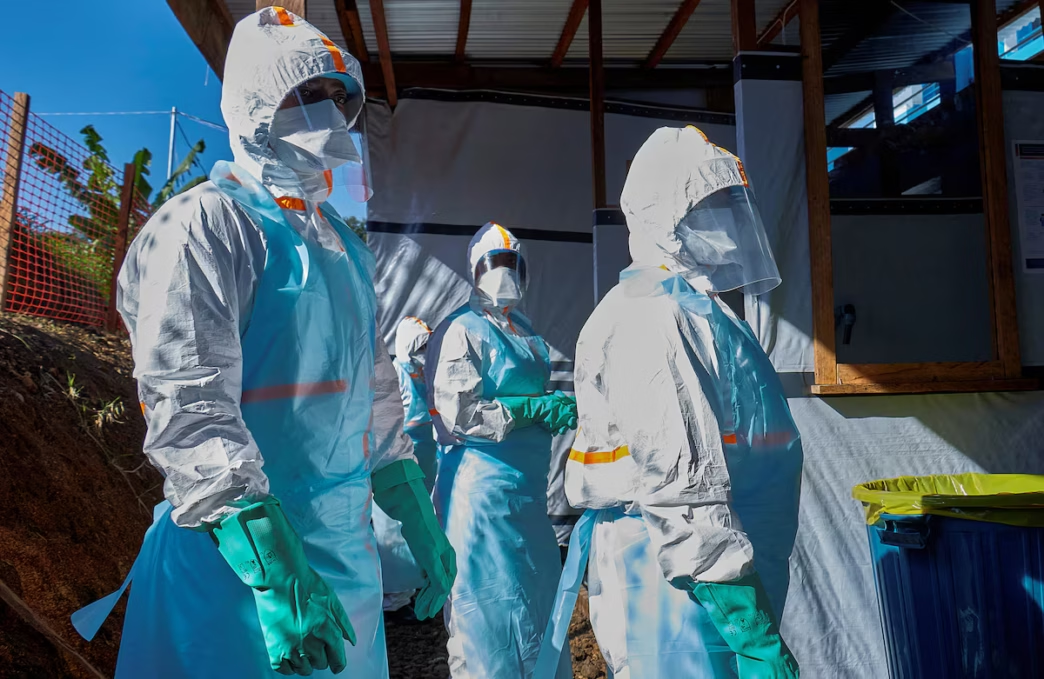
Kenya has confirmed its third Ebola case, involving a 65-year-old woman linked to the country’s first two patients, the Ministry of Health announced on Friday.
The woman, identified as a close relative of the first two cases, had been in quarantine since October 6. The ministry said she developed symptoms including fever, a sore throat and general weakness before testing positive for the virus.
She was subsequently isolated for treatment, while health officials continued efforts to contain the outbreak.
Read More : Kenya Seeks New Multilateral Financing
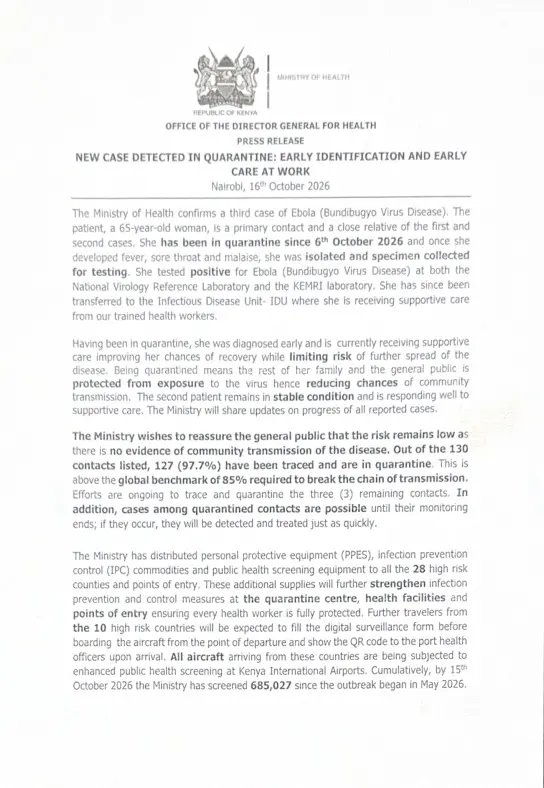
“The Ministry of Health confirms a third case of Ebola (Bundibugyo Virus Disease). The patient, a 65-year-old woman, is a primary contact and a close relative of the first and second cases.
“She has been in quarantine since 6th October 2026, and once she developed fever, sore throat and malaise, she was isolated and specimen collected for testing.
“She tested positive for Ebola (Bundibugyo Virus Disease) at both the National Virology Reference Laboratory and the KEMRI laboratory.
“She has since been transferred to the Infectious Disease Unit- IDU where she is receiving supportive care from our trained health workers,” the statement read.
The ministry said the risk to the wider public remained low, adding that there was no evidence of community transmission.
Of the 130 people identified as contacts of confirmed cases, 127 had been traced and placed in quarantine, while efforts continued to locate the remaining three.
“The Ministry wishes to reassure the general public that the risk remains low as there is no evidence of community transmission of the disease. Out of the 130 contacts listed, 127 (97.7%) have been traced and are in quarantine.
“This is above the global benchmark of 85% required to break the chain of transmission.
“Efforts are ongoing to trace and quarantine the three (3) remaining contacts. In addition, cases among quarantined contacts are possible until their monitoring ends; if they occur, they will be detected and treated just as quickly,” the statement added.
Kenya reported its first Ebola case last week after a 40-year-old Kenyan businessman died following his return from the Democratic Republic of the Congo (DRC), where he had been receiving treatment.
The man, whose identity was not publicly disclosed, reportedly fell ill about a month before his death. He travelled overland to Kampala, Uganda, before flying to Nairobi on October 3. He was admitted to a hospital in the Kenyan capital but died on October 5, according to Health Minister Aden Duale.
Kenya confirmed its second case on Wednesday, involving a 39-year-old relative of the first patient. The man was placed in isolation, with authorities reporting no evidence of widespread transmission.
The DRC declared its 17th Ebola outbreak in May. Congolese health authorities have reported 9,066 infections and 4,381 deaths linked to the Bundibugyo strain, which has no approved vaccine or specific treatment.
The Ebola virus has killed more than 15,000 people across Africa over the past five decades.
Neighbouring Uganda also experienced an outbreak, recording 20 infections, including two deaths. Nearly all those infected had travelled from the DRC. Uganda was declared Ebola-free in August.
Kenyan health authorities said they were continuing surveillance, contact tracing and quarantine measures to prevent further spread of the virus.
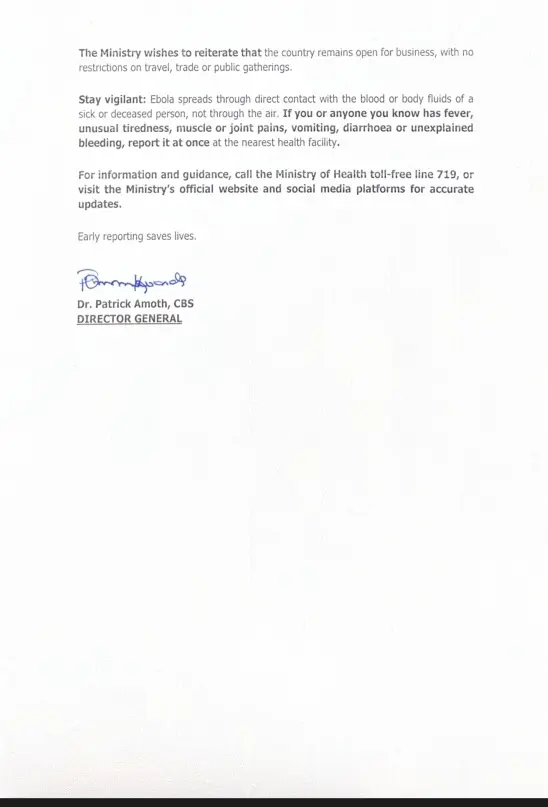
“The Ministry has distributed personal protective equipment (PPES), infection prevention control (IPC) commodities and public health screening equipment to all the 28 high risk counties and points of entry.
“These additional supplies will further strengthen infection prevention and control measures at the quarantine centre, health facilities and points of entry ensuring every health worker is fully protected.
“Further travelers from the 10 high risk countries will be expected to fill the digital surveillance form before boarding the aircraft from the point of departure and show the QR code to the port health officers upon arrival,” it stated.